How to Integrate WhatsApp Business Into Your Zimbabwe App: The Complete Guide
Introduction
WhatsApp is not just a messaging app in Zimbabwe — it is the backbone of commerce. From a Mbare market vendor sending product photos to a Borrowdale boutique processing orders, WhatsApp is where business happens. But there is a significant gap between using WhatsApp casually for business and integrating it properly into a custom app that automates your operations, scales with your growth, and delivers a professional customer experience.
This guide is for Zimbabwe business owners who are ready to bridge that gap. Whether you run a retail shop in Gweru, a logistics company in Harare, or a service business in Bulawayo, integrating WhatsApp Business API into your custom app can transform how you communicate with customers, process orders, and manage your team — all through the platform your customers already use every day.
We will cover everything: what WhatsApp Business API actually is, how it differs from the free WhatsApp Business App, what it costs, how to integrate it with EcoCash and other local payment systems, and real examples of Zimbabwe businesses that have done it successfully.
What Is WhatsApp Business API — And Why Does It Matter for Zimbabwe?
Most Zimbabwe business owners are familiar with the free WhatsApp Business App — the version you download from the Play Store, set up a business profile, and use to chat with customers. It is a great starting point, but it has significant limitations that become painful as your business grows.
The WhatsApp Business API (now called the WhatsApp Cloud API) is a completely different product. It is designed for businesses that need to:
- Handle hundreds or thousands of customer conversations simultaneously
- Automate responses, order confirmations, and appointment reminders
- Integrate WhatsApp into their existing business app or website
- Accept payments directly within the WhatsApp conversation
- Assign conversations to different team members from a single number
- Send bulk notifications to opted-in customers
The Key Differences at a Glance
Here is how the two products compare:
- Cost: WhatsApp Business App is free; the API uses pay-per-conversation pricing
- Simultaneous users: The App supports 1 device; the API supports unlimited agents
- Automation: The App offers basic auto-replies; the API enables full chatbot and workflow automation
- CRM integration: None with the App; full integration possible with the API
- Payment processing: Not available in the App; EcoCash, card, and bank transfer supported via API
- Verification badge: Not available in the App; green tick available via API
For a small business just starting out, the free app is fine. But once you are handling more than 50 customer conversations per day, or you want to automate order processing, the API becomes essential.
Why Zimbabwe Is Uniquely Positioned for WhatsApp Commerce
Zimbabwe has one of the highest WhatsApp penetration rates in Africa. Research from Techzim indicates that over 85% of smartphone users in Zimbabwe have WhatsApp installed, and a significant portion of small business transactions — particularly in retail, food, and services — are initiated through WhatsApp.
This creates a massive opportunity. When you integrate WhatsApp Business API into your custom app, you are not asking customers to download something new or change their behaviour. You are meeting them exactly where they already are, with a professional, automated experience that feels seamless.
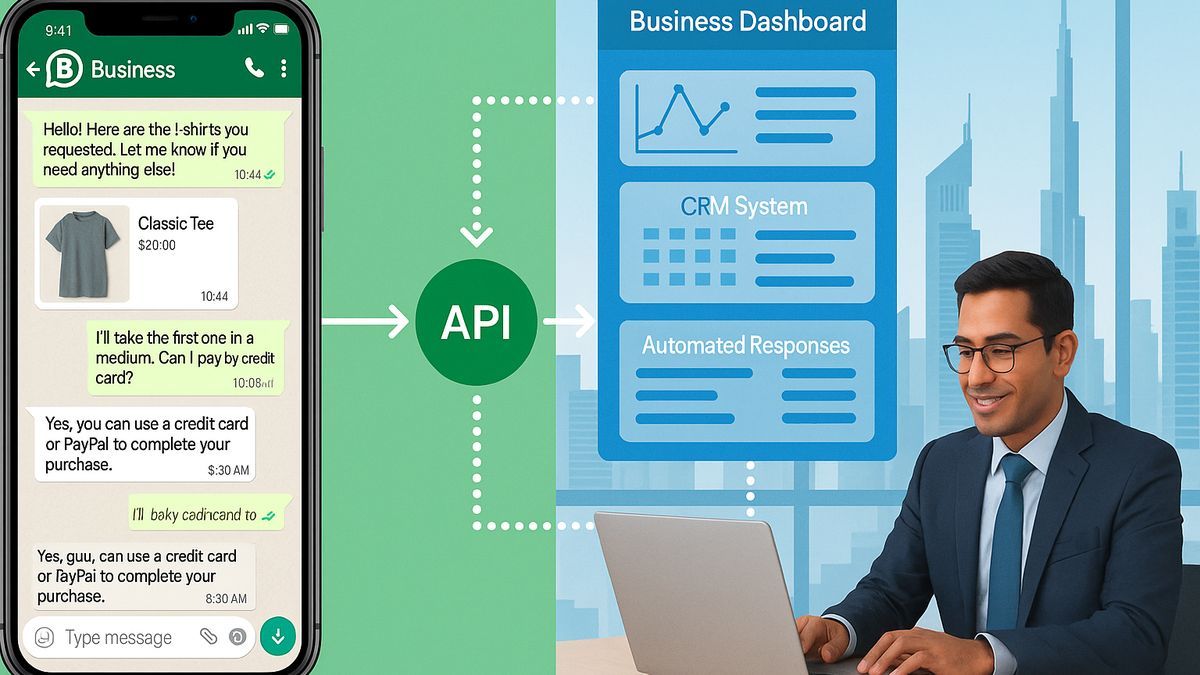
How WhatsApp Business API Integration Works
Understanding the technical architecture helps you make better decisions about your integration. Here is how it works in plain language.
The Three-Layer Architecture
Layer 1: Meta's WhatsApp Cloud API
This is the official API provided by Meta (WhatsApp's parent company). It handles message delivery, read receipts, media sharing, and the core messaging infrastructure. You access it through Meta's Business Manager platform.
Layer 2: Your Business App or Backend
This is the custom app or system that ZimNinja Apps builds for your business. It connects to the WhatsApp API, processes incoming messages, triggers automated responses, and integrates with your inventory, booking, or payment systems.
Layer 3: Business Solution Providers (BSPs)
For many Zimbabwe businesses, working directly with Meta's API requires technical expertise. BSPs like UPWAW, Cellfind, and CM.com act as intermediaries — they handle the technical setup and provide user-friendly dashboards for managing your WhatsApp business account. ZimNinja Apps works with these providers to deliver integrated solutions.
The Message Flow
When a customer sends your business a WhatsApp message, here is what happens in an integrated system:
- Customer sends "Hi, I want to order 2kg of beef" to your WhatsApp business number
- The message arrives at the WhatsApp Cloud API
- Your business app receives the message via webhook (an automatic notification)
- Your app's AI or rule-based system processes the message
- The system checks your inventory, calculates the price, and generates a response
- An automated reply is sent back: "Great! 2kg of beef is $8.50. Shall I add it to your order? Reply YES to confirm or NO to cancel."
- The customer replies YES
- Your app generates an EcoCash payment request and sends the payment link
- Once payment is confirmed, your app updates inventory and notifies your team
- The customer receives an order confirmation with estimated delivery time
This entire flow — from customer message to payment confirmation — can happen in under 60 seconds, with zero manual intervention from your team.
Integrating WhatsApp with EcoCash and Zimbabwe Payment Systems
The most powerful aspect of WhatsApp Business API integration for Zimbabwe businesses is the ability to accept payments directly within the conversation. This is a game-changer in a market where EcoCash is the dominant payment method.
EcoCash Integration via WhatsApp
Here is how a WhatsApp-to-EcoCash payment flow works in practice:
Step 1: Customer initiates purchase
The customer messages your WhatsApp number with their order or service request.
Step 2: App generates payment request
Your integrated app calculates the total and generates an EcoCash payment request. This can be done in two ways:
- EcoCash push payment: Your system sends an EcoCash push notification to the customer's registered mobile number, prompting them to enter their PIN to approve the payment
- Payment link: Your system generates a Paynow or EcoCash payment link and sends it as a WhatsApp message
Step 3: Payment confirmation
Once the customer completes payment, EcoCash sends a confirmation to your system via API. Your app automatically updates the order status and sends the customer a receipt via WhatsApp.
Step 4: Fulfilment notification
Your team receives an automatic notification (via WhatsApp or your internal system) with the order details, ready for processing.
Real Example: Chikwanda Fresh Produce, Harare
Chikwanda Fresh Produce, a wholesale fruit and vegetable supplier based in Mbare, Harare, integrated WhatsApp Business API with EcoCash payment processing in early 2026. Before integration, their process was entirely manual: customers would WhatsApp their orders, a staff member would manually calculate totals, send payment details, wait for EcoCash confirmation screenshots, and then process the order.
The results after integration:
- Order processing time: Reduced from 25 minutes to under 3 minutes
- Payment confirmation errors: Eliminated (previously 8-12 fake payment screenshots per week)
- Staff time saved: 4 hours per day previously spent on manual order processing
- Customer satisfaction: 94% of customers rated the new process as "much easier"
- Revenue increase: 34% increase in order volume within 3 months, attributed to faster processing and reduced friction
The integration cost Chikwanda approximately $1,800 for development and setup, with ongoing API costs of around $45 per month. They recovered the investment within 6 weeks through increased order volume and reduced staffing costs.
Other Payment Methods You Can Integrate
Beyond EcoCash, WhatsApp Business API can be integrated with:
- OneMoney (NetOne): Zimbabwe's second-largest mobile money platform
- Telecash (Telecel): Growing mobile money service
- Paynow: Zimbabwe's leading online payment gateway, supporting multiple payment methods
- Visa/Mastercard: For customers with international cards
- Bank transfers: With automated confirmation via bank API
A well-integrated system can present customers with multiple payment options within the WhatsApp conversation, letting them choose their preferred method.
Automating Customer Service with WhatsApp Chatbots
Beyond payments, WhatsApp Business API enables sophisticated customer service automation that can dramatically reduce the burden on your team while improving the customer experience.
What a WhatsApp Chatbot Can Handle
A properly built WhatsApp chatbot for a Zimbabwe business can autonomously handle:
For retail businesses:
- Product availability checks
- Price inquiries
- Order placement and tracking
- Return and exchange requests
- Store hours and location information
For service businesses:
- Appointment booking and confirmation
- Service price quotes
- Appointment reminders (sent automatically 24 hours and 1 hour before)
- Rescheduling requests
- Post-service feedback collection
For logistics and delivery:
- Delivery status updates
- Estimated arrival time queries
- Proof of delivery confirmation
- Complaint logging
For hospitality (restaurants, hotels):
- Table reservations
- Menu inquiries and daily specials
- Order placement for delivery or collection
- Loyalty points balance checks
- Special dietary requirement recording
Building a Chatbot That Understands Zimbabwean Communication
One of the most important considerations for Zimbabwe businesses is building a chatbot that understands how Zimbabweans actually communicate. This means:
Handling mixed language: Many Zimbabwean customers naturally mix English with Shona or Ndebele in their messages. A well-built chatbot should recognise common Shona phrases like "ndoda" (I want) or "mangwanani" (good morning) and respond appropriately.
Understanding informal language: Customers rarely type perfectly formatted requests. "yo send me 2 loaves n sum milk" should be understood as an order for 2 loaves of bread and milk.
Handling abbreviations and shortcuts: "asap", "pls", "thx", "nw" (now), and other common abbreviations should be recognised.
Graceful escalation: When the chatbot cannot understand a message or the customer's request is too complex, it should smoothly hand over to a human agent with full conversation context.
Case Study: Sunshine Pharmacy, Bulawayo
Sunshine Pharmacy, a community pharmacy in Bulawayo's Nkulumane suburb, implemented a WhatsApp chatbot in March 2026 to handle prescription refill requests and general medication inquiries.
Before the chatbot, the pharmacy received an average of 180 WhatsApp messages per day. Two staff members spent approximately 3 hours each per day responding to messages — time taken away from serving in-store customers.
After implementing the WhatsApp chatbot:
- 85% of messages are now handled entirely by the chatbot without human intervention
- Prescription refill requests are processed automatically: the chatbot checks stock, confirms availability, and sends a collection notification when the prescription is ready
- Staff time saved: 5.5 hours per day, allowing staff to focus on in-store customer care
- Response time: Average response time reduced from 47 minutes to under 30 seconds
- Customer complaints about slow responses: Dropped by 91%
The pharmacy also uses the WhatsApp integration to send automated medication reminders to chronic patients — a feature that has improved medication adherence and generated significant goodwill in the community.
Setting Up WhatsApp Business API: Step-by-Step Process
If you are ready to integrate WhatsApp Business API into your Zimbabwe business app, here is the process:
Step 1: Verify Your Business on Meta Business Manager
Before you can access the WhatsApp Business API, you need a verified Meta Business Manager account. This requires:
- A valid business registration document (certificate of incorporation or business name registration)
- A business website or Facebook page
- A phone number that is not already registered on WhatsApp
The verification process typically takes 3-7 business days. ZimNinja Apps handles this process for clients as part of the integration package.
Step 2: Choose Your Integration Approach
There are two main approaches:
Direct API integration: Your custom app connects directly to Meta's WhatsApp Cloud API. This gives maximum flexibility and control but requires more technical expertise to set up and maintain.
BSP-mediated integration: You work through a Business Solution Provider (BSP) that handles the API connection and provides a management dashboard. This is simpler to set up and often includes additional features like team inbox management and analytics.
For most Zimbabwe businesses, ZimNinja Apps recommends a hybrid approach: using a BSP for the WhatsApp connection and management interface, while building custom integrations with your specific business systems (inventory, payments, booking) on top.
Step 3: Design Your Conversation Flows
Before any code is written, you need to map out the conversations your WhatsApp integration will handle. This involves:
- Identifying the top 10-15 most common customer inquiries or requests
- Designing the conversation flow for each (what the bot says, what options it presents, how it handles unexpected responses)
- Defining escalation triggers (when to hand over to a human agent)
- Creating message templates for notifications (order confirmations, appointment reminders, payment receipts)
This design phase typically takes 1-2 weeks and involves close collaboration between ZimNinja Apps and your team.
Step 4: Build and Test the Integration
The development phase involves:
- Setting up the WhatsApp Cloud API connection
- Building the chatbot logic and conversation flows
- Integrating with your payment systems (EcoCash, Paynow, etc.)
- Connecting to your inventory, booking, or CRM system
- Building the team inbox interface for human agents
- Setting up analytics and reporting
Testing is critical. We test every conversation flow with real scenarios, including edge cases like customers sending unexpected messages, payment failures, and system errors.
Step 5: Train Your Team
Even with a highly automated system, your team needs to understand how to use the team inbox to manage escalated conversations, how to handle situations the chatbot cannot resolve, how to update product information and prices in the system, and how to read the analytics dashboard and identify improvement opportunities.
Step 6: Launch and Optimise
We recommend a soft launch — starting with a subset of customers or a single product category — before rolling out to your full customer base. This allows you to identify and fix issues before they affect all your customers. After launch, the first 30 days are critical for optimisation. We monitor conversation completion rates, escalation rates, and customer satisfaction scores, and make adjustments to improve performance.
WhatsApp Business API Costs for Zimbabwe Businesses
Understanding the cost structure helps you plan your investment and calculate ROI.
Meta's Conversation-Based Pricing
Meta charges per conversation, not per message. A conversation is a 24-hour window of messages between your business and a customer. There are two types:
Business-initiated conversations: When your business sends the first message (e.g., an order confirmation or appointment reminder). These cost approximately $0.0147 per conversation for Zimbabwe.
User-initiated conversations: When the customer sends the first message. These are free for the first 1,000 conversations per month, then approximately $0.0147 per conversation.
For a business handling 500 customer conversations per month, the Meta API cost would be approximately $7-15 per month — extremely affordable.
Development and Setup Costs
The one-time development cost for a WhatsApp Business API integration in Zimbabwe typically ranges from:
- Basic integration (chatbot + EcoCash payments, no CRM): $800 - $1,500
- Standard integration (chatbot + payments + inventory sync): $1,500 - $3,000
- Advanced integration (full CRM, multi-agent inbox, analytics dashboard): $3,000 - $6,000
ROI Calculation
Let us calculate the ROI for a typical Harare retail business:
Before integration:
- 2 staff members spending 3 hours/day on WhatsApp customer service
- Average staff cost: $8/hour
- Monthly cost: 2 × 3 × 22 working days × $8 = $1,056/month
After integration:
- 85% of conversations automated
- Staff time reduced to 45 minutes/day
- Monthly staff cost: 2 × 0.75 × 22 × $8 = $264/month
- Monthly API and platform costs: $120/month
- Total monthly cost: $384/month
Monthly saving: $672 | Annual saving: $8,064 | Development investment: $2,500 | Payback period: 3.7 months
This does not account for revenue increases from faster response times and 24/7 availability — which typically add another 15-25% to the ROI.
Common Mistakes Zimbabwe Businesses Make with WhatsApp Integration
Mistake 1: Trying to Automate Everything at Once
The most common mistake is attempting to build a chatbot that handles every possible customer scenario from day one. This leads to a complex, expensive system that takes months to build and is full of edge cases that frustrate customers.
The better approach: Start with the 3-5 most common customer requests and automate those perfectly. Add more capabilities over time based on actual usage data.
Mistake 2: Ignoring the Human Handover
Some businesses build WhatsApp chatbots with no mechanism for handing over to a human agent. When the chatbot cannot handle a request, customers get stuck in a loop of unhelpful automated responses.
The better approach: Always build a clear escalation path. When the chatbot cannot help, it should immediately connect the customer to a human agent with full conversation context.
Mistake 3: Using Informal Numbers
Many Zimbabwe businesses start using WhatsApp Business API on a personal phone number that already has WhatsApp installed. This creates complications and can result in losing access to the number.
The better approach: Use a dedicated business phone number for your WhatsApp Business API integration. This number should not have WhatsApp installed on any device.
Mistake 4: Neglecting Message Templates
WhatsApp requires pre-approved message templates for business-initiated messages (notifications, reminders, etc.). Businesses that skip this step find themselves unable to send proactive messages to customers.
The better approach: Identify all the notification types you need (order confirmations, appointment reminders, payment receipts) and get the templates approved before launch.
Mistake 5: Not Measuring Performance
Many businesses set up WhatsApp integration and never look at the analytics. Without data, you cannot identify what is working, what is frustrating customers, or where the biggest improvement opportunities are.
The better approach: Set up a simple dashboard tracking conversation completion rate, escalation rate, average response time, and customer satisfaction score. Review it weekly.
Key Takeaways
- WhatsApp Business API is fundamentally different from the free WhatsApp Business App — it enables automation, multi-agent management, payment integration, and unlimited scale
- Zimbabwe's high WhatsApp penetration makes it the ideal channel for customer communication — you are meeting customers where they already are
- EcoCash and Paynow integration within WhatsApp eliminates payment friction and dramatically reduces order processing time
- A well-built WhatsApp chatbot can handle 80-90% of customer inquiries automatically, freeing your team to focus on complex issues and in-person service
- The ROI is compelling — most Zimbabwe businesses recover their integration investment within 3-6 months through staff time savings and increased order volume
- Start simple and scale — automate your top 3-5 customer requests first, then expand based on real usage data
Frequently Asked Questions
How much does WhatsApp Business API cost for a small Zimbabwe business?
For a small business handling 200-500 customer conversations per month, the total monthly cost (Meta API fees + BSP platform + hosting) typically ranges from $60-120 per month. The one-time development cost for a basic integration starts at around $800. Most businesses recover this investment within 3-6 months through staff time savings alone.
Can I keep my existing WhatsApp Business App number when switching to the API?
Yes, in most cases you can migrate your existing WhatsApp Business App number to the API. However, this process requires careful planning — you will lose your chat history and need to notify customers of the transition. ZimNinja Apps handles this migration process for clients to minimise disruption.
Does WhatsApp Business API work with EcoCash?
Yes. WhatsApp Business API can be integrated with EcoCash through Paynow's payment gateway or directly through EcoCash's merchant API. This allows customers to initiate and complete EcoCash payments entirely within the WhatsApp conversation, without needing to switch apps or visit a website.
How long does it take to set up WhatsApp Business API integration?
A basic integration (chatbot + payment processing) typically takes 4-6 weeks from project start to launch. This includes Meta Business Manager verification (1-2 weeks), development (2-3 weeks), and testing (1 week). More complex integrations with full CRM and inventory sync can take 8-12 weeks.
What happens if the chatbot cannot understand a customer's message?
A well-built WhatsApp chatbot should have a clear escalation path. When it cannot understand a message or the customer's request is too complex, it should immediately notify a human agent and hand over the conversation with full context. The customer should never feel stuck or ignored. ZimNinja Apps builds this escalation mechanism into every WhatsApp integration we deliver.
Related Articles
About ZimNinja Apps Team
ZimNinja Apps is Zimbabwe's leading PWA development company, specializing in affordable, high-performance Progressive Web Apps for small and medium businesses. Based in Bulawayo and serving clients across Zimbabwe, we've helped hundreds of businesses transform their operations through smart digital solutions.