Why Zimbabwe Logistics Companies Need Custom Delivery Tracking Apps
Introduction
Imagine this: You're running a logistics company in Harare, managing 15 delivery vehicles and 25 drivers. It's 3 PM on a busy Thursday, and your phone is ringing off the hook. A corporate client in Borrowdale is demanding to know where their urgent package is—it was supposed to arrive by 2 PM. You frantically call the driver, who doesn't answer because he's driving. You try the dispatcher, who's checking a messy spreadsheet and making calls to other drivers. Twenty minutes later, you finally discover the package is stuck in traffic on Samora Machel Avenue, still 45 minutes away. The client is furious, threatens to switch to a competitor, and you've just wasted 30 minutes that could have been spent growing your business.
Meanwhile, your competitor—a smaller logistics company that started just two years ago—is thriving. Their clients can track deliveries in real-time on their phones, receive automatic updates, and know exactly when packages will arrive. Their drivers follow optimized routes that save 2-3 hours daily. Their dispatchers manage 30+ vehicles effortlessly from a single dashboard. They're closing deals you're losing, and they're doing it with fewer resources and less stress.
The difference? A custom delivery tracking app that costs them $12,000 one-time plus $250/month ongoing—less than the salary of one additional dispatcher—but delivers 10x the value.
Zimbabwe's logistics industry is at a critical turning point. With e-commerce growing 40-60% annually, businesses demanding faster delivery, and customers expecting Amazon-level tracking, logistics companies that rely on phone calls, WhatsApp messages, and manual dispatch are losing ground fast. The inefficiencies are staggering: 25-35% of revenue lost to poor route planning, 40% customer churn due to lack of visibility, 20+ hours weekly wasted on manual coordination, and 15-25% of deliveries delayed or failed.
But here's the opportunity: Custom delivery tracking apps are transforming Zimbabwe logistics companies—from solo courier services to large freight operations. These apps typically cost $8,000-18,000 one-time plus $200-350/month ongoing, and companies report 30-45% cost reduction, 50-70% improvement in customer retention, and 35-60% increase in delivery capacity within 6-12 months.
In this comprehensive guide, we'll show you exactly how delivery tracking apps work, what features drive results, real success stories from Zimbabwe logistics companies, detailed cost breakdowns, and how to choose the right solution for your operation—whether you're in Harare, Bulawayo, Gweru, Mutare, or anywhere in Zimbabwe.
The Hidden Cost of Manual Logistics Operations
Before we explore solutions, let's quantify what manual logistics operations are costing you. Most Zimbabwe logistics companies still rely on phone calls, WhatsApp groups, paper waybills, and basic spreadsheets. This seems to work... until you calculate the opportunities you're losing.
The Real Cost of "Traditional" Delivery Management
Let's examine a typical Zimbabwe logistics company with 10-15 vehicles, 20-25 drivers, and 100-150 deliveries per day:
Inefficient Route Planning (Wasted Fuel & Time):- Manual route planning by dispatchers
- Routes based on "experience" not data
- No real-time traffic consideration
- Drivers take suboptimal routes
- Backtracking and unnecessary mileage
- Result: 25-35% more fuel consumption and 2-4 hours wasted daily per vehicle
- Customers call asking "Where's my package?"
- No real-time tracking or updates
- Customers feel anxious and uninformed
- Missed deliveries due to poor communication
- Negative reviews and word-of-mouth
- Result: 30-40% customer churn, 50% fewer referrals
- Dispatchers spend 60-80% of time on phone calls
- Coordinating pickups and deliveries manually
- Answering customer inquiries
- Tracking driver locations via phone
- Resolving issues reactively
- Result: 2-3 full-time dispatchers needed for work that could be automated
- 15-25% of deliveries delayed or failed
- Customer not home (no advance notification)
- Wrong address (no verification)
- Driver can't find location
- Rescheduling costs time and money
- Result: Lost revenue, refunds, damaged reputation
- Don't know which routes are most profitable
- Can't identify underperforming drivers
- No data on peak times or demand patterns
- Can't optimize pricing or capacity
- Making decisions based on gut feeling
- Result: 15-25% lower profitability than data-driven competitors
- No real-time vehicle tracking
- Drivers use vehicles for personal errands
- Fuel theft and unauthorized stops
- Vehicle theft risk
- No accountability
- Result: 10-15% of fuel budget lost to theft/misuse
- Paper waybills and signatures
- Drivers return with paperwork at end of day
- Manual data entry and filing
- Invoicing delayed by 3-7 days
- Cash flow problems
- Result: 5-10 day payment delays, cash flow strain
- Vehicles return half-empty
- No backhaul optimization
- Can't dynamically reassign deliveries
- Capacity wasted due to poor planning
- Result: 30-40% underutilization of vehicle capacity
- Modern clients expect real-time tracking
- E-commerce businesses require API integration
- Corporate clients demand professional systems
- Losing bids to tech-enabled competitors
- Result: 20-30% market share loss over 2-3 years
That's potentially 50-70% of a typical mid-size logistics company's annual revenue lost to preventable inefficiencies!
Now imagine recovering 60-80% of those losses with a delivery tracking app that costs $12,000-15,000 one-time plus $250-300/month ongoing. The ROI is extraordinary.
Why Traditional Methods Fail Modern Logistics Companies
1. No Real-Time Visibility- Don't know where vehicles are at any moment
- Can't provide accurate ETAs to customers
- Can't respond quickly to issues
- Customers feel anxious and uninformed
- Reactive instead of proactive management
- Constant phone calls between dispatchers and drivers
- Drivers distracted while driving (safety risk)
- Information gets lost or miscommunicated
- No centralized communication history
- Difficult to manage multiple conversations
- Routes planned manually based on "experience"
- No consideration of real-time traffic
- Suboptimal stop sequences
- Excessive mileage and fuel consumption
- Wasted time and money
- Adding vehicles multiplies complexity exponentially
- Dispatcher workload becomes unmanageable
- Quality and efficiency decline with growth
- Growth becomes a burden instead of opportunity
- Can't verify driver locations or activities
- No proof of delivery timestamps
- Difficult to identify performance issues
- Drivers can misuse vehicles without detection
- No data for performance reviews
- Paper-based waybills and signatures
- Drivers return with paperwork at end of day
- Manual data entry and filing
- Invoicing delayed by days
- Cash flow problems
- Customers have no visibility into deliveries
- Must call to get updates
- Missed deliveries due to poor communication
- Frustration and anxiety
- High churn rate
- Don't know which routes are profitable
- Can't identify trends or patterns
- No data for optimization
- Making decisions blindly
- Missing opportunities
- Vehicle theft risk
- Fuel theft and misuse
- Unauthorized stops and detours
- No geofencing or alerts
- Financial losses
- Can't integrate with e-commerce platforms
- Manual order entry
- No API for corporate clients
- Losing business to integrated competitors
How Delivery Tracking Apps Transform Logistics Operations
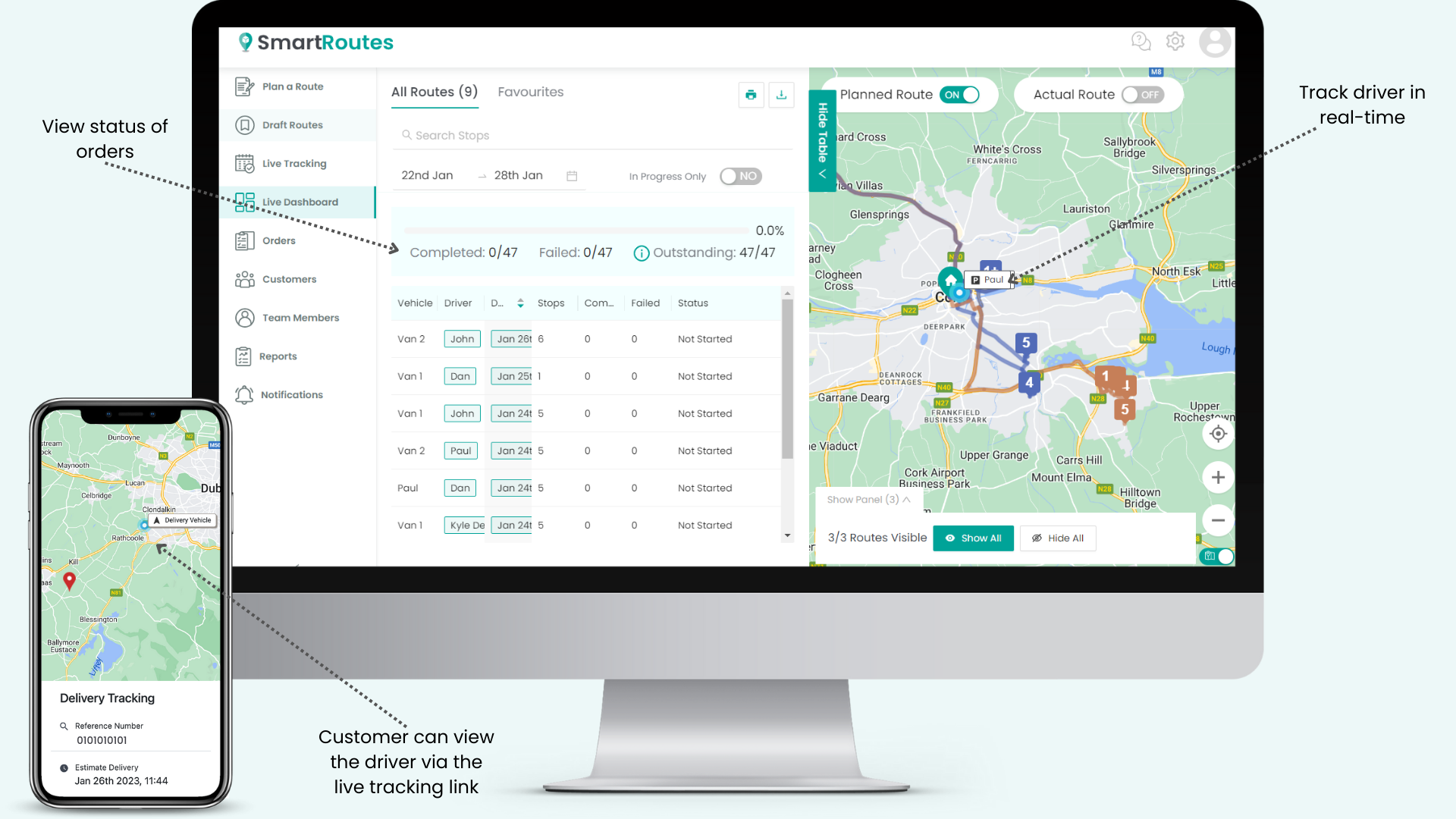
Modern delivery tracking apps solve all these problems through real-time GPS tracking, intelligent route optimization, automated communication, and comprehensive business intelligence. Here's how:
Core Features That Drive Results
1. Real-Time GPS Tracking How It Works:- GPS device or mobile app tracks vehicle location every 10-30 seconds
- Location data sent to cloud server
- Displayed on live map dashboard
- Historical route playback available
- Geofencing and alerts for unauthorized areas
- ✅ Know where every vehicle is at all times
- ✅ Provide accurate ETAs to customers
- ✅ Respond quickly to issues or delays
- ✅ Prevent vehicle theft and misuse
- ✅ Verify driver routes and stops
- ✅ Improve security and accountability
- Automatic route planning based on delivery addresses
- Optimizes stop sequence to minimize distance and time
- Considers real-time traffic conditions
- Accounts for delivery time windows
- Balances load across vehicles
- Dynamic rerouting for new urgent deliveries
- ✅ Reduce fuel consumption 20-35%
- ✅ Complete 30-50% more deliveries per day
- ✅ Reduce vehicle wear and maintenance costs
- ✅ Improve on-time delivery rates
- ✅ Reduce driver stress and fatigue
- Customers receive tracking link via SMS/email
- View real-time delivery location on map
- See accurate ETA (updates automatically)
- Receive automatic status updates
- Contact driver or support directly
- Rate delivery experience
- ✅ Reduce "Where's my package?" calls by 70-85%
- ✅ Improve customer satisfaction dramatically
- ✅ Reduce missed deliveries (customers prepare for arrival)
- ✅ Professional, modern customer experience
- ✅ Increase customer retention 50-70%
- Orders automatically assigned to optimal driver
- Considers driver location, capacity, and schedule
- Balances workload across team
- Dynamic reassignment for urgent deliveries
- Driver receives delivery details on mobile app
- No phone calls needed
- ✅ Reduce dispatcher workload 60-80%
- ✅ Faster dispatch (seconds vs. minutes)
- ✅ Optimal driver utilization
- ✅ Handle more deliveries with same staff
- ✅ Reduce errors and miscommunication
- Receive delivery assignments instantly
- Turn-by-turn navigation to each stop
- View delivery details (address, contact, special instructions)
- Call or message customer with one tap
- Digital proof of delivery (signature, photo)
- Update delivery status in real-time
- Report issues or delays
- ✅ Drivers always know where to go next
- ✅ Reduce time spent on phone with dispatcher
- ✅ Faster deliveries (no confusion or delays)
- ✅ Instant proof of delivery
- ✅ Better driver experience
- Customer signature captured on mobile device
- Photo of delivered package
- GPS coordinates and timestamp
- Recipient name and ID verification
- Instantly uploaded to cloud
- Accessible to customer and office immediately
- ✅ Eliminate paper waybills
- ✅ Instant proof of delivery (no waiting for paperwork)
- ✅ Faster invoicing and payment
- ✅ Resolve disputes quickly with photo evidence
- ✅ Improve cash flow
- Automatic SMS/email when package is out for delivery
- ETA updates as driver approaches
- "Driver is 10 minutes away" notification
- Delivery confirmation with POD photo
- Failed delivery notification with reason
- Customizable notification templates
- ✅ Keep customers informed proactively
- ✅ Reduce anxiety and uncertainty
- ✅ Reduce missed deliveries (customers prepare)
- ✅ Professional customer experience
- ✅ Reduce customer service workload
- Live map showing all vehicles
- Vehicle status (active, idle, offline)
- Current and completed deliveries
- Driver performance metrics
- Alerts for issues or delays
- Historical route playback
- Geofencing and unauthorized area alerts
- ✅ Manage entire fleet from one screen
- ✅ Identify and resolve issues quickly
- ✅ Monitor driver performance
- ✅ Improve accountability
- ✅ Make data-driven decisions
- Delivery performance metrics (on-time %, success rate)
- Driver performance (deliveries per day, customer ratings)
- Route efficiency analysis
- Fuel consumption tracking
- Revenue and profitability by route/customer
- Peak time and demand analysis
- Custom reports and dashboards
- ✅ Identify top and underperforming drivers
- ✅ Optimize routes and schedules
- ✅ Reduce costs and improve profitability
- ✅ Make data-driven business decisions
- ✅ Identify growth opportunities
- Customers create accounts and book deliveries online
- View delivery history and invoices
- Track active deliveries
- Download POD documents
- Manage addresses and preferences
- Request quotes and schedule pickups
- ✅ Reduce phone calls and manual order entry
- ✅ 24/7 booking availability
- ✅ Professional customer experience
- ✅ Reduce administrative workload
- ✅ Attract corporate clients
- API for e-commerce platforms (WooCommerce, Shopify, custom)
- Automatic order import
- Real-time tracking link sent to customers
- Delivery status updates to e-commerce platform
- Automated invoicing and reconciliation
- ✅ Attract e-commerce clients (growing market)
- ✅ Eliminate manual order entry
- ✅ Seamless integration with client systems
- ✅ Competitive advantage
- ✅ Recurring revenue from e-commerce partnerships
- Generate unique barcode/QR code for each package
- Scan at pickup, warehouse, and delivery
- Automatic status updates
- Verify correct package at each step
- Reduce errors and lost packages
- ✅ Reduce package loss and misdelivery
- ✅ Improve accuracy and accountability
- ✅ Faster processing at warehouse
- ✅ Professional operations
- ✅ Attract corporate clients
- Plan routes with 20-100+ stops
- Optimize stop sequence automatically
- Consider delivery time windows
- Balance load across vehicles
- Export routes to driver apps
- ✅ Handle high-volume delivery routes efficiently
- ✅ Reduce planning time from hours to minutes
- ✅ Optimal route efficiency
- ✅ Increase deliveries per vehicle per day
- Track COD amounts for each delivery
- Driver records cash collected
- Automatic reconciliation at end of day
- Alerts for discrepancies
- Financial reporting
- ✅ Reduce cash handling errors
- ✅ Improve accountability
- ✅ Faster reconciliation
- ✅ Reduce theft and fraud
- ✅ Better financial control
- Track vehicle mileage automatically
- Schedule maintenance based on mileage or time
- Maintenance reminders and alerts
- Track maintenance history and costs
- Identify vehicles with high maintenance costs
- ✅ Prevent breakdowns and costly repairs
- ✅ Extend vehicle lifespan
- ✅ Reduce maintenance costs 15-25%
- ✅ Improve fleet reliability
- ✅ Better budgeting and planning
Real Zimbabwe Success Stories
Let's look at actual results from Zimbabwe logistics companies that implemented delivery tracking apps:
Case Study 1: Small Courier Service in Harare (5 Vehicles)
Company Profile:- Small courier service
- 5 delivery vehicles (motorcycles and vans)
- 8 drivers
- 50-80 deliveries per day
- $15,000-20,000 monthly revenue
- Serving e-commerce and small businesses
- Customers constantly calling asking "Where's my package?"
- Dispatcher overwhelmed with phone calls
- Inefficient routes (drivers choosing own routes)
- High fuel costs
- 20-25% missed deliveries (customer not home)
- Losing business to competitors with tracking
- No proof of delivery (disputes)
- Custom delivery tracking PWA
- Real-time GPS tracking
- Route optimization
- Customer tracking portal
- Automated SMS notifications
- Mobile driver app with navigation
- Digital proof of delivery
- Basic analytics dashboard
- Cost: $8,500 one-time + $180/month ongoing
- ✅ Customer service calls reduced from 60-80 daily to 10-15 (81% reduction)
- ✅ Fuel costs reduced 28% (better routes)
- ✅ Deliveries per vehicle increased from 12 to 18 per day (50% increase)
- ✅ Missed deliveries reduced from 22% to 7% (automated notifications)
- ✅ Customer satisfaction score increased from 6.8 to 9.2/10
- ✅ Customer retention improved 65%
- ✅ Secured 3 e-commerce clients (required tracking)
- ✅ Revenue increased from $17,500 to $28,000 monthly (60% growth)
- ✅ Dispatcher workload reduced 70% (can now manage 12 vehicles)
- Previous monthly revenue: $17,500
- New monthly revenue: $28,000
- Additional revenue: $10,500/month = $126,000/year
- Fuel savings: $1,200/month = $14,400/year
- Total annual benefit: $140,400
- Investment: $8,500 + $2,160 = $10,660
- First-year ROI: 1,217%
- Payback period: 0.9 months
- Year 2+ ROI: 6,400% (only ongoing costs)
Case Study 2: Mid-Size Logistics Company in Bulawayo (15 Vehicles)
Company Profile:- Established logistics company
- 15 delivery vehicles (vans and trucks)
- 25 drivers
- 120-180 deliveries per day
- $60,000-75,000 monthly revenue
- Serving retail, wholesale, and corporate clients
- 3 full-time dispatchers overwhelmed
- Inefficient routes wasting fuel and time
- Poor customer communication
- High customer churn (40% annually)
- Vehicle misuse and fuel theft suspected
- Paper-based POD causing invoicing delays
- Losing bids to competitors with modern systems
- Difficult to scale beyond 15 vehicles
- Comprehensive fleet management platform
- Real-time GPS tracking with geofencing
- Advanced route optimization
- Automated dispatch and assignment
- Customer tracking portal
- Mobile driver app
- Digital POD with photos
- Fleet management dashboard
- Analytics and reporting
- Customer portal for self-service booking
- API integration for e-commerce clients
- Cost: $13,200 one-time + $280/month ongoing
- ✅ Fuel costs reduced 32% (route optimization + reduced theft)
- ✅ Deliveries per vehicle increased from 10 to 16 per day (60% increase)
- ✅ Dispatcher workload reduced 75% (1 dispatcher now manages all 15 vehicles)
- ✅ Customer churn reduced from 40% to 12% annually
- ✅ Invoicing time reduced from 5 days to same-day
- ✅ Secured 8 new e-commerce clients (API integration)
- ✅ Revenue increased from $67,500 to $115,000 monthly (70% growth)
- ✅ Successfully expanded to 22 vehicles (scalability)
- ✅ Customer satisfaction increased from 7.1 to 9.4/10
- Previous monthly revenue: $67,500
- New monthly revenue: $115,000
- Additional revenue: $47,500/month = $570,000/year
- Fuel savings: $6,400/month = $76,800/year
- Labor savings (2 dispatchers): $1,600/month = $19,200/year
- Total annual benefit: $666,000
- Investment: $13,200 + $3,360 = $16,560
- First-year ROI: 3,922%
- Payback period: 0.4 months (12 days!)
- Year 2+ ROI: 19,721% (only ongoing costs)
Case Study 3: Large Freight Company in Harare (30+ Vehicles)
Company Profile:- Large freight and logistics company
- 32 vehicles (trucks, vans, motorcycles)
- 50+ drivers
- 300-400 deliveries per day
- $180,000-220,000 monthly revenue
- Serving major retailers, wholesalers, and manufacturers
- Multiple depots in Harare and Chitungwiza
- 6 dispatchers struggling to coordinate operations
- Frequent vehicle theft and misuse
- High fuel costs (suspected theft)
- Poor on-time delivery performance (65%)
- Major clients threatening to switch
- Difficult to manage multi-depot operations
- No visibility into profitability by route or client
- Losing market share to competitors
- Enterprise fleet management system
- Real-time GPS tracking with advanced geofencing
- AI-powered route optimization
- Automated dispatch with load balancing
- Multi-depot management
- Customer tracking portal with branded experience
- Mobile driver app with advanced features
- Digital POD with barcode scanning
- Comprehensive analytics and business intelligence
- API integration for major clients
- Vehicle maintenance tracking
- COD management
- Cost: $17,500 one-time + $350/month ongoing
- ✅ Fuel costs reduced 38% (optimization + eliminated theft)
- ✅ On-time delivery improved from 65% to 94%
- ✅ Deliveries per vehicle increased 45%
- ✅ Dispatcher workload reduced 80% (3 dispatchers now manage 32 vehicles)
- ✅ Vehicle theft incidents eliminated (was 3-4 per year)
- ✅ Retained 2 major clients who were about to leave
- ✅ Secured 5 new major corporate clients
- ✅ Revenue increased from $200,000 to $310,000 monthly (55% growth)
- ✅ Profitability increased 85% (cost reduction + revenue growth)
- ✅ Successfully expanded to Victoria Falls (new market)
- Previous monthly revenue: $200,000
- New monthly revenue: $310,000
- Additional revenue: $110,000/month = $1,320,000/year
- Fuel savings: $18,000/month = $216,000/year
- Labor savings (3 dispatchers): $2,400/month = $28,800/year
- Vehicle theft prevention: $60,000/year
- Total annual benefit: $1,624,800
- Investment: $17,500 + $4,200 = $21,700
- First-year ROI: 7,387%
- Payback period: 0.2 months (6 days!)
- Year 2+ ROI: 38,471% (only ongoing costs)
Case Study 4: Specialized Cold Chain Logistics in Gweru
Company Profile:- Specialized cold chain logistics
- 8 refrigerated vehicles
- 12 drivers
- 40-60 deliveries per day
- $35,000-45,000 monthly revenue
- Serving pharmacies, restaurants, and food retailers
- Clients demanding temperature monitoring
- No proof of temperature compliance
- Losing contracts to competitors with monitoring
- Inefficient routes (time-sensitive deliveries)
- High fuel costs
- Difficult to prove cold chain integrity
- Cold chain logistics platform
- Real-time GPS tracking
- Temperature monitoring integration
- Route optimization with time windows
- Customer tracking with temperature data
- Mobile driver app
- Digital POD with temperature logs
- Compliance reporting
- Cost: $11,800 one-time + $240/month ongoing
- ✅ Secured 4 major pharmaceutical contracts (required temperature monitoring)
- ✅ Fuel costs reduced 26%
- ✅ Deliveries per vehicle increased 38%
- ✅ Zero temperature compliance violations (was 2-3 per month)
- ✅ Revenue increased from $40,000 to $68,000 monthly (70% growth)
- ✅ Positioned as premium cold chain provider
- ✅ Expanded to Harare market
- Previous monthly revenue: $40,000
- New monthly revenue: $68,000
- Additional revenue: $28,000/month = $336,000/year
- Fuel savings: $2,200/month = $26,400/year
- Total annual benefit: $362,400
- Investment: $11,800 + $2,880 = $14,680
- First-year ROI: 2,369%
- Payback period: 0.5 months (15 days)
- Year 2+ ROI: 12,517% (only ongoing costs)
Essential Features for Zimbabwe Logistics Apps
Not all delivery tracking apps are created equal. Here are the must-have features for Zimbabwe logistics companies:
Must-Have Features (Non-Negotiable)
1. Real-Time GPS Tracking- Track all vehicles in real-time
- Live map dashboard
- Historical route playback
- Works on mobile data and offline
- Essential for visibility and security
- Automatic route planning
- Optimizes stop sequence
- Considers traffic and time windows
- 20-35% fuel savings
- 30-50% more deliveries per day
- Customers track deliveries in real-time
- Accurate ETA updates
- Automatic notifications
- 70-85% reduction in customer calls
- Essential for customer satisfaction
- Receive assignments instantly
- Turn-by-turn navigation
- Digital proof of delivery
- Update status in real-time
- Essential for driver efficiency
- Signature capture
- Photo of delivered package
- GPS and timestamp
- Instant upload to cloud
- Faster invoicing and payment
- Automatic driver assignment
- Optimal workload distribution
- 60-80% reduction in dispatcher workload
- Essential for scalability
- Manage entire fleet from one screen
- Vehicle status and locations
- Delivery progress monitoring
- Alerts for issues
- Essential for operations management
- Delivery performance metrics
- Driver performance tracking
- Route efficiency analysis
- Fuel consumption tracking
- Essential for optimization
- Zimbabwe's primary communication channels
- Automatic delivery updates
- ETA notifications
- Delivery confirmation
- Essential for customer communication
- Works perfectly on smartphones
- Fast loading on slow connections
- Offline functionality
- Essential for Zimbabwe's mobile-first market
Highly Recommended Features
11. Customer Portal & Self-Service- Online booking and quotes
- Delivery history
- Invoice management
- Reduce administrative workload
- 24/7 availability
- Integrate with e-commerce platforms
- Automatic order import
- Essential for e-commerce clients
- Competitive advantage
- Track packages at each step
- Reduce errors and loss
- Professional operations
- Attract corporate clients
- Define authorized areas
- Alerts for unauthorized locations
- Prevent vehicle misuse
- Improve security
- Track cash collected
- Automatic reconciliation
- Reduce theft and errors
- Essential for COD-heavy operations
- Automatic mileage tracking
- Maintenance scheduling
- Reduce breakdowns 60-80%
- Extend vehicle lifespan
Nice-to-Have Features (Specialty-Specific)
17. Temperature Monitoring (for cold chain)- Real-time temperature tracking
- Alerts for temperature violations
- Compliance reporting
- Essential for pharmaceuticals and food
- Manage multiple locations
- Inter-depot transfers
- Consolidated reporting
- Essential for multi-city operations
- Optimize vehicle loading
- Weight and volume calculations
- Maximize capacity utilization
- Reduce trips
- Rate drivers on multiple metrics
- Identify top performers
- Coaching opportunities
- Incentive programs
What Delivery Tracking Apps Cost in Zimbabwe
Let's break down realistic pricing for Zimbabwe logistics companies:
Small Operation (1-5 Vehicles)
Typical Company: Small courier service, startup logistics Features Needed:- Real-time GPS tracking
- Basic route optimization
- Customer tracking portal
- Mobile driver app
- Digital POD
- SMS notifications
- Basic analytics
- 1-5 vehicle tracking
- Custom PWA: $7,000-10,000 one-time + $150-220/month ongoing
Medium Operation (6-15 Vehicles)
Typical Company: Established logistics company, growing courier service Features Needed:- All small operation features plus:
- Advanced route optimization
- Automated dispatch
- Fleet management dashboard
- Customer portal
- Advanced analytics
- API integration
- Barcode scanning
- 6-15 vehicle tracking
- Comprehensive platform: $10,000-14,000 one-time + $220-300/month ongoing
Large Operation (16-30+ Vehicles)
Typical Company: Large logistics company, freight operations Features Needed:- All medium operation features plus:
- Multi-depot management
- Advanced load optimization
- Vehicle maintenance tracking
- COD management
- Advanced security features
- Custom integrations
- Dedicated support
- 16-30+ vehicle tracking
- Enterprise platform: $14,000-20,000 one-time + $300-450/month ongoing
Specialty Operations (Unique Requirements)
Cold Chain Logistics:- Temperature monitoring integration
- Compliance reporting
- Alert systems
- Cost: $10,000-15,000 one-time + $240-320/month
- Advanced API integrations
- Multi-platform support
- Automated order processing
- Cost: $9,000-13,000 one-time + $200-280/month
- Inter-city route optimization
- Fuel management
- Driver fatigue monitoring
- Cost: $12,000-17,000 one-time + $260-360/month
Ongoing Costs Breakdown
Hosting & Infrastructure: $50-120/month- Secure server hosting
- Database storage
- GPS data processing
- Daily backups
- SSL certificates
- Bug fixes
- Security updates
- Technical support
- Feature updates
- Depends on delivery volume
- $0.05-0.10 per message
- 200-1,000 notifications per month
- GPS tracking data
- Map services
- Routing algorithms
Key Takeaways
- Manual logistics operations cost Zimbabwe companies 50-70% of revenue through inefficiencies, poor customer experience, and missed opportunities
- Delivery tracking apps deliver 30-45% cost reduction, 50-70% improvement in customer retention, and 35-60% increase in delivery capacity within 6-12 months
- ROI is extraordinary: Most Zimbabwe logistics companies see payback in 1-4 months and 200-7,000% first-year ROI
- Essential features include: Real-time GPS tracking, route optimization, customer tracking portal, mobile driver app, digital POD, automated dispatch, and analytics
- Pricing is affordable: $7,000-20,000 one-time + $150-450/month ongoing—less than the cost of one additional dispatcher but delivering 10x the value
Frequently Asked Questions
1. How long does it take to implement a delivery tracking app?
Answer: Implementation typically takes 3-6 weeks from start to full launch. Week 1-2: Requirements gathering, design, and development setup. Week 2-4: Core development and testing. Week 4-5: Training and soft launch with a few vehicles. Week 5-6: Full launch with all vehicles. The timeline depends on complexity, number of vehicles, and custom integrations needed. Most Zimbabwe logistics companies are fully operational within 4-5 weeks.
2. Do I need to buy GPS devices or can I use drivers' smartphones?
Answer: Both options work, each with pros and cons. Smartphone-based tracking: Lower cost (no hardware purchase), easier setup, drivers use their own phones. Cons: Depends on driver cooperation, battery drain, less reliable. Dedicated GPS devices: More reliable, can't be turned off by drivers, better for security, longer battery life. Cons: Higher upfront cost ($80-150 per device). Recommendation: Start with smartphone-based for 1-5 vehicles, upgrade to dedicated GPS devices as you scale or if you have security concerns. Many Zimbabwe companies use a hybrid approach—smartphones for motorcycles, GPS devices for trucks.
3. What if my drivers don't have smartphones or data?
Answer: This is a common concern in Zimbabwe. Solutions: (1) Company-provided smartphones: Provide basic Android smartphones ($80-120 each) to drivers—the efficiency gains far exceed the cost. (2) Data bundles: Provide monthly data bundles ($5-10/month per driver)—minimal cost compared to benefits. (3) Offline functionality: Modern apps work offline and sync when connection is available. (4) SMS-based updates: Drivers can send status updates via SMS if no data available. Most Zimbabwe logistics companies find that providing smartphones and data is a small investment (under $150 per driver one-time + $10/month) that pays for itself within weeks through improved efficiency.
4. Can the app integrate with my existing accounting or ERP system?
Answer: Yes, most custom delivery tracking apps can integrate with popular accounting and ERP systems through APIs. Common integrations include: QuickBooks, Sage, Xero, Pastel, and custom ERP systems. Integration allows automatic invoice generation, financial reporting, and data synchronization. Cost: $1,500-3,500 one-time for standard integrations, $3,000-6,000 for complex custom integrations. Benefit: Eliminates manual data entry, reduces errors, faster invoicing, better financial visibility. Most Zimbabwe logistics companies integrate with their accounting system within 2-3 months of launching the delivery app.
5. What happens if internet connection is lost during delivery?
Answer: Modern delivery tracking apps are designed for Zimbabwe's connectivity challenges with robust offline functionality: (1) Offline mode: Driver app continues working without internet—stores data locally. (2) Automatic sync: When connection is restored, all data (locations, PODs, status updates) automatically syncs to cloud. (3) SMS fallback: Critical updates can be sent via SMS if data is unavailable. (4) Local caching: Route information and delivery details cached on device for offline access. In practice, GPS tracking works continuously (GPS doesn't require internet), and data syncs whenever connection is available. Zimbabwe logistics companies report 95-98% uptime even with intermittent connectivity.
Related Articles
- Retail Revolution: How Inventory Management Apps Boost Zimbabwe Retailers
- Real Estate Apps That Help Zimbabwe Property Agents Close More Deals
- How AI is Transforming Small Businesses in Bulawayo and Harare
Ready to transform your logistics operations? Get a free consultation and custom quote for your delivery tracking app today. Join the growing number of Zimbabwe logistics companies cutting costs 30-45%, boosting customer retention 50-70%, and increasing delivery capacity 35-60% with custom delivery tracking apps.
About ZimNinja Apps Team
ZimNinja Apps is Zimbabwe's leading PWA development company, specializing in affordable, high-performance Progressive Web Apps for small and medium businesses. Based in Bulawayo and serving clients across Zimbabwe, we've helped hundreds of businesses transform their operations through smart digital solutions.