Progressive Web Apps for Zimbabwe Businesses: The Complete Guide
Progressive Web Apps for Zimbabwe Businesses: The Complete Guide
Here is a scenario that plays out every week across Zimbabwe. A business owner decides they need a mobile app. They get quotes from developers: $8,000 for Android, another $8,000 for iOS, plus $200 a month in maintenance. Then they find out they need to wait 2 to 4 weeks for Apple to approve their app before customers can even download it. And if a customer has a low-storage phone, they might not install it at all.
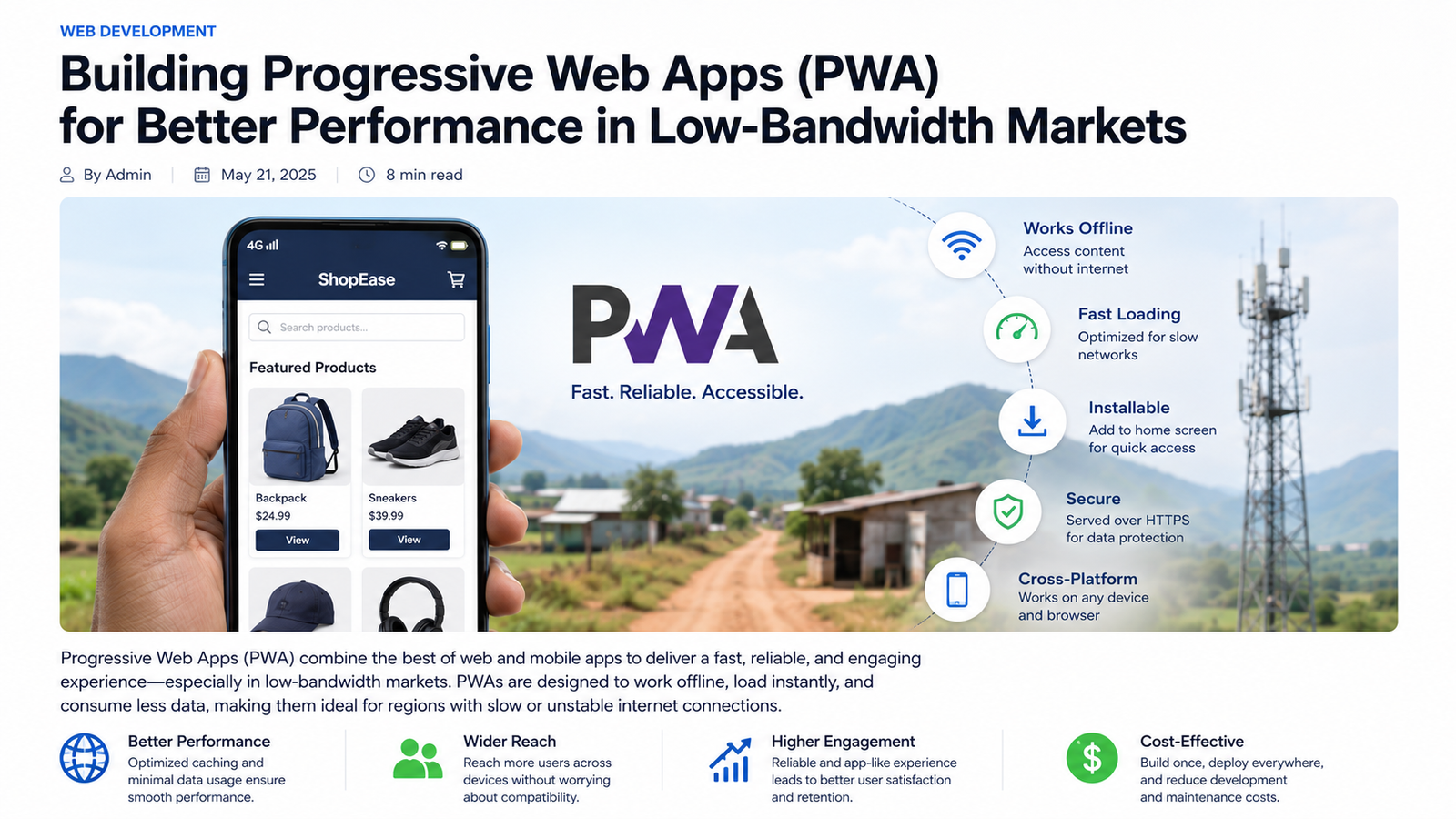
Progressive Web Apps (PWAs) solve every one of those problems. A PWA is a website that behaves like a native mobile app: it works offline, sends push notifications, installs on a home screen, and loads fast even on slow connections. You build it once and it runs on every device. No app store required.
For Zimbabwe businesses dealing with high data costs, inconsistent connectivity, and budget constraints, PWAs are not just a good option. In many cases, they are the smarter option. This guide breaks down exactly what PWAs are, what they cost, and how businesses in Harare, Bulawayo, and beyond are using them to grow.
What Is a Progressive Web App?
A Progressive Web App is a web application built with standard web technologies (HTML, CSS, JavaScript) that uses modern browser features to deliver an experience that feels like a native app. The key technologies that make this possible are:
- Service Workers: Background scripts that cache content so the app works offline or on slow connections
- Web App Manifest: A configuration file that tells the browser how to display the app when installed on a home screen
- HTTPS: Secure connection required for service workers to function
- Push Notifications: The ability to send messages to users even when they are not actively using the app
When a customer visits your PWA on their phone, they see a prompt to "Add to Home Screen." One tap later, your app icon sits on their phone alongside their native apps. No Play Store. No App Store. No download waiting.
PWA vs Native App: The Key Differences
The debate between PWAs and native apps comes down to your specific situation. Here is a straightforward comparison for Zimbabwe businesses:
- Development cost: PWA typically $2,000 to $5,000 vs native Android + iOS at $12,000 to $25,000
- Time to launch: PWA 6 to 10 weeks vs native 4 to 6 months
- App store approval: PWA requires none vs native requires 1 to 4 weeks
- Updates: PWA updates instantly for all users vs native requires users to download updates
- Offline capability: Both support offline use when built correctly
- Device features: Native apps access more hardware features (camera, GPS, Bluetooth) with fewer limitations
- Discoverability: PWAs are indexed by Google; native apps require app store search
For most Zimbabwe SMEs, the PWA wins on cost and speed. For businesses needing deep hardware integration (like a delivery tracking app using GPS constantly in the background), native may still be the right call.
Why PWAs Work Especially Well in Zimbabwe
Zimbabwe's digital landscape has specific characteristics that make PWAs particularly well-suited here. Understanding these factors helps explain why local businesses are increasingly choosing PWAs over native apps.
High Data Costs and Low Bandwidth
Mobile data in Zimbabwe costs significantly more per gigabyte than in Europe or North America. Customers are careful about what they download and how much data they use. A native app might require 50MB to 100MB to download. A PWA typically loads in under 1MB on first visit, then caches content locally so subsequent visits use almost no data.
Econet and NetOne customers on prepaid bundles notice this difference immediately. When your app uses less data, customers use it more often.
Older and Mid-Range Devices
Many Zimbabwe consumers use mid-range Android phones with 16GB to 32GB of storage. These devices fill up quickly. When storage is tight, customers delete apps they do not use daily. A PWA takes up a fraction of the space of a native app, making it far less likely to get deleted.
Inconsistent Connectivity
Load shedding affects internet connectivity. Rural areas have patchy coverage. Even in Harare, connections drop. A PWA with proper service worker caching lets customers browse your product catalogue, fill in order forms, or check their account balance even when offline. The data syncs when connectivity returns.
No App Store Friction
Getting customers to download an app is hard. Research consistently shows that for every step between a customer and your product, you lose a percentage of them. With a PWA, a customer clicks a link in a WhatsApp message, lands on your app, and can start using it immediately. The "Add to Home Screen" prompt is optional, not required.
Real Zimbabwe Businesses Using PWA Technology
These examples show how businesses across Zimbabwe have applied PWA principles to solve real problems.
Harare Grocery Delivery: Cutting App Abandonment by 40%
A grocery delivery service in Harare's Avondale suburb launched a native Android app in 2024. Downloads were decent, but they noticed a pattern: customers would download the app, place one or two orders, then delete it to free up storage. Repeat order rates were low.
In early 2026, they rebuilt as a PWA. The app loads in under 2 seconds on a 3G connection. Customers who add it to their home screen get push notifications for order updates and weekly specials. Storage footprint dropped from 45MB to under 3MB.
Within three months, repeat order rates increased by 38%. Customer support calls about "app not working" dropped by 60% because the PWA works consistently across all Android versions. Total development cost for the PWA rebuild: $3,800, compared to the $9,500 they spent on the original native app.
Bulawayo Hardware Retailer: Reaching Customers Without Smartphones
A hardware retailer in Bulawayo's CBD wanted a digital catalogue so customers could browse stock and check prices before visiting the store. Their customer base skewed older, with many using basic Android phones that struggled with large app downloads.
They built a PWA catalogue with offline support. Customers could browse the full product range, save items to a wishlist, and generate a shopping list, all without a data connection once the initial load was complete. The PWA worked on phones as old as Android 5.0.
The retailer saw a 25% increase in customers arriving at the store with a prepared shopping list, which correlated with a 20% increase in average transaction value. The PWA cost $2,200 to build and $80 per month to maintain.
Gweru Transport Company: Real-Time Tracking Without Native App Complexity
A passenger transport company operating routes between Gweru and Harare needed a way for passengers to track bus locations and book seats. Building native apps for both Android and iOS was quoted at $18,000. They could not justify that cost for a route with 200 to 300 daily passengers.
A PWA with real-time GPS tracking (using the browser's geolocation API) and an online booking system cost $4,500 to build. Passengers access it via a link shared on WhatsApp. No download required. The booking system integrated with their existing EcoCash payment setup.
Within six months, online bookings accounted for 35% of all seat reservations, reducing the workload on their booking office staff. The company saved an estimated $13,500 compared to native app development, and the PWA reached passengers on every type of smartphone.
What Features Can a PWA Include?
Modern PWAs support a wide range of features that were previously only possible in native apps. Here is what Zimbabwe businesses can realistically include:
Core Features Available in All PWAs
- Offline browsing of cached content (product catalogues, menus, schedules)
- Push notifications to re-engage customers
- Home screen installation with custom icon and splash screen
- Fast loading via service worker caching
- Responsive design that works on any screen size
- Form submissions that queue offline and sync when connected
Advanced Features for Specific Use Cases
- Camera access: For QR code scanning, photo uploads, or document capture
- Geolocation: For delivery tracking, store finders, or location-based services
- Payment integration: EcoCash, InnBucks, and card payments via Paynow
- Background sync: Syncing data when connectivity returns after offline use
- Barcode scanning: For inventory management or loyalty card scanning
Features That Still Require Native Apps
Be honest with your developer about what you need. Some features are still better or only possible in native apps:
- Continuous background GPS tracking (for delivery driver apps)
- Bluetooth device communication (for POS hardware integration)
- NFC payments (tap-to-pay)
- Deep integration with phone contacts or calendar
- Complex augmented reality features
If your use case does not require any of these, a PWA will almost certainly meet your needs.
PWA Development Costs in Zimbabwe
Cost is often the deciding factor for Zimbabwe SMEs. Here is a realistic breakdown of what PWA development costs locally.
Basic PWA (Brochure + Catalogue)
A simple PWA with product catalogue, contact forms, offline support, and home screen installation typically costs $1,500 to $3,000. This suits retailers, restaurants, and service businesses that want a fast, installable web presence without complex functionality.
Standard PWA (E-commerce or Booking)
A PWA with user accounts, online ordering or booking, payment integration (EcoCash/Paynow), push notifications, and an admin dashboard typically costs $3,500 to $7,000. This is the most common category for Zimbabwe SMEs moving from WhatsApp-based ordering to a proper digital system.
Advanced PWA (Complex Business Logic)
A PWA with real-time features (live tracking, chat, inventory sync), complex offline functionality, multiple user roles, and third-party integrations typically costs $7,000 to $15,000. This competes directly with native app functionality at a fraction of the cost.
Ongoing Costs
After launch, budget for:
- Hosting: $20 to $80 per month depending on traffic
- Maintenance and updates: $100 to $300 per month
- SSL certificate: Often included with hosting, or $50 to $100 per year
Compare this to native app maintenance, which typically runs $300 to $600 per month when you factor in both Android and iOS updates.
How to Choose Between a PWA and a Native App
Use this decision framework to guide your choice:
Choose a PWA if:
- Your budget is under $10,000 for initial development
- You need to launch quickly (under 3 months)
- Your customers are on a mix of Android and iOS devices
- Your core features are content, ordering, booking, or account management
- SEO and organic search traffic matter to your business
- You want to avoid app store approval delays and policies
- Your customers are data-conscious or on older devices
Choose a Native App if:
- You need continuous background GPS or Bluetooth
- Your app is a game or requires heavy graphics processing
- You need deep integration with phone hardware
- App store presence and discoverability are critical to your marketing strategy
- You have the budget for ongoing dual-platform maintenance
Consider Both if:
Some businesses launch a PWA first to validate their concept and build a user base, then invest in native apps once they have proven demand and revenue. This phased approach reduces risk significantly. You spend $4,000 on a PWA, prove the concept works, then invest $15,000 in native apps with confidence.
Getting Your PWA Found: SEO Advantages
One area where PWAs have a clear advantage over native apps is search engine visibility. Native apps are invisible to Google. A PWA is a website, so every page can be indexed and ranked.
For a Harare restaurant, this means their menu page can rank for "best pizza Harare" in Google search. For a Bulawayo hardware store, their product pages can rank for specific product searches. Native apps cannot do this.
To maximise your PWA's SEO:
- Ensure every key page has a unique URL (not a single-page app with no deep links)
- Use proper HTML headings and structured content
- Implement schema markup for your business type
- Optimise page load speed (Google's Core Web Vitals are a ranking factor)
- Build local SEO signals: Google Business Profile, local citations, Zimbabwe-specific content
Key Takeaways
- PWAs cost 60 to 80% less than native apps and launch in weeks, not months, making them ideal for Zimbabwe SMEs with limited budgets
- Offline functionality and low data usage address Zimbabwe's specific connectivity and data cost challenges directly
- No app store approval means you can update your PWA instantly and reach customers without download friction
- PWAs are indexed by Google, giving you SEO benefits that native apps cannot provide
- Most Zimbabwe business use cases (ordering, booking, catalogues, loyalty programmes) are fully achievable with a PWA
Frequently Asked Questions
Can a PWA send push notifications like a native app?
Yes, on Android devices PWAs support push notifications fully. On iOS, Apple added PWA push notification support in iOS 16.4 (2023), so most iPhone users can now receive them too. The setup requires a bit more configuration than native push notifications, but the functionality is equivalent for most business use cases.
Will my PWA work on all phones in Zimbabwe?
PWAs work on any device with a modern browser. Chrome on Android (the most common browser in Zimbabwe) has full PWA support. Safari on iPhone supports most PWA features. Even older Android phones running Chrome can use PWAs, though some advanced features like background sync may not be available on very old versions.
How does a PWA handle EcoCash and other Zimbabwe payment methods?
PWAs integrate with payment gateways exactly like any website. Paynow supports EcoCash, InnBucks, and card payments via their API, which works seamlessly in a PWA. The payment flow opens in the browser, completes, and returns the user to your app. This is the same flow used by most Zimbabwe e-commerce sites today.
Do I still need a website if I have a PWA?
Your PWA is your website. It serves both purposes: it is accessible via browser on desktop and laptop computers, and it installs as an app on mobile devices. You do not need a separate website and a separate app. This is one of the key cost advantages of the PWA approach.
How long does it take to build a PWA in Zimbabwe?
A basic PWA takes 4 to 6 weeks. A standard e-commerce or booking PWA takes 8 to 12 weeks. A complex PWA with real-time features and multiple integrations takes 3 to 5 months. These timelines are significantly shorter than native app development, which typically takes 4 to 8 months for a quality product on both platforms.
Related Articles
About ZimNinja Apps Team
ZimNinja Apps is Zimbabwe's leading PWA development company, specializing in affordable, high-performance Progressive Web Apps for small and medium businesses. Based in Bulawayo and serving clients across Zimbabwe, we've helped hundreds of businesses transform their operations through smart digital solutions.